


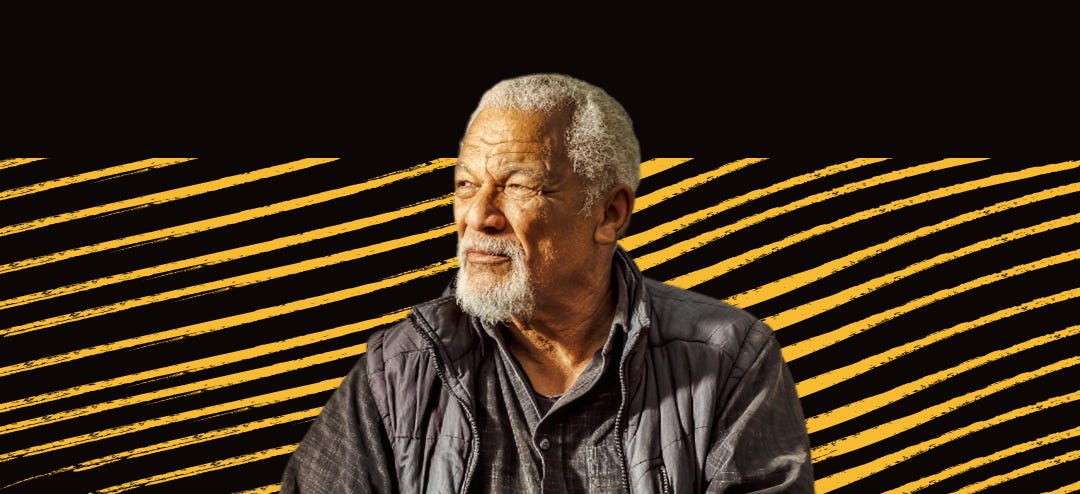
Photo of the H.E. Ross
Wanaago Geedi: How did you come to connect sailing and writing?
H.E. Ross: Well, I guess they sort of go together. No, they don’t. Well, they do. When I was about 16, I used to go down to this place in North Beach. I looked older, so I was able to get into bars. One bar was called The Anxious Asp. I met the bartender named Bob, and we got to be really good friends.
Much later, after I got out of the Marines we met up again. We went out on this point in San Francisco, where there’s an entrance to the marina, and we were sitting there, messed up. He said to me something like, “Look at those boats out there.” And I said, “What boats?” And he said, “Those boats. That’s what you should be on.” I looked out. I was born and raised in San Francisco, and I went down to that spot all the time to fish, and I never saw the sailboats. There was a wooden boat race, and I just didn’t see them. I didn’t identify with them. So, I saw those boats and thought, “Oh my God, you’re right! I should be out there.”
I was doing this acting thing then with a group called The Committee, and I quit that completely and went into sailing. I would call people, telling them I wanted to buy their boats. My first sail was aboard a double-ender for a guy who was quite drunk early that morning. But, calling people and eventually telling them that I didn’t have any money was how I learned how to sail. I did that for a year and a half, five days a week, and I became a fanatic about it. I did buy a little boat and sailed all the time.
I got a job at a sailboat sales company and had 30 to 50 boats to maintain and do demonstration sails with, learning a lot about different types of boats and I also did some ocean deliveries. I bought a 36-foot wooden yawl and my wife and son, Ian, lived aboard. Most of the boats I have had were wooden.
Much later and after two divorces and another child, a daughter, Maya, I worked at the start of the Bay Area Marine Institute. I got us some money from the city, and out of the Institute’s first nine kids, two were court referrals. I taught Black sailing heritage as a base, to train them, and put them on as boats for hands on sailing lessons. I have found that streetwise young Bloods have a natural inclination for sailing, because of the life balance needed and awareness of what’s around you needed on the streets.
Out of those first nine, seven of them stayed in sailing. Two volunteered to help build a big steel sloop for charter work and one had a boatyard in San Diego.
I left the Bay Area Marine Institute to start a project I had been trying to do for years. Invisible Sailors Invisible Ships, or Project ISIS, which started while I was working for the Pulitzer Prize Winning Point Reyes Light Newspaper, led me to the Caribbean to research active Black sailing cultures, first in the Cayman Islands with a rich history of building beautifully crafted blue water sailing vessels.
Reading your work and learning about your experiences as a sailor and your research into the Horn of Africa and the first people to migrate out of Africa has been really inspiring and really interesting. I was so excited for the opportunity to meet you!
Unfortunately, African maritime history under sail is not something that is researched comprehensively by many academics. It seems like most are just staying with what was written before and exploring that, and not looking into what it could be past that to explore.
Logically, from a Sailor’s point of view, it definitely doesn’t make any sense that people’d be walking from our human DNA starting point at the Horn up the continent of Africa with water all around and back down the Arabian Peninsula to that DNA continuance. We have even been taught that Africans are afraid of water. Which brings up the question of why are we taught that? I want us to go deeper than asking that by stimulating interest in filling in the blanks by looking at our blue planet migration through the use of water.
There is something about the United States, and experiencing racialization in very particular ways, that often divorces people from their relationship with water. An inherited trauma of some kind. I know so many people from my community who can’t swim or are afraid, but their parents swam in open water.
Well, I spent a lot of time in the Turks and Caicos and the Cayman Islands. Cayman in particular, two British overseas territories. In Cayman, they have Olympic swimming competitors but in the Turks and Caicos children played at the edges of the water and actually dove sometimes for food and commerce but did not swim much. In both places we established sailing maritime heritage organisations with swimming a qualification for going out sailing. We took out almost 600 kids, three at a time, for over a four year period.
I want to stimulate an interest in our history of seafaring, or even just getting in the water. It doesn’t make any sense for us, of all people, not to research our involvement with the evolution of sailing. But to study it you have to get people interested. To get our people interested we have to let them know that there is a history that has not been shown and a basis of familiarity with getting aboard a sailing vessel. Once we understand we have the longest history and heritage in sailing I feel we can get more connected to the water, and on the water. With that connection, we will get further studies of this invisible history that is our heritage.
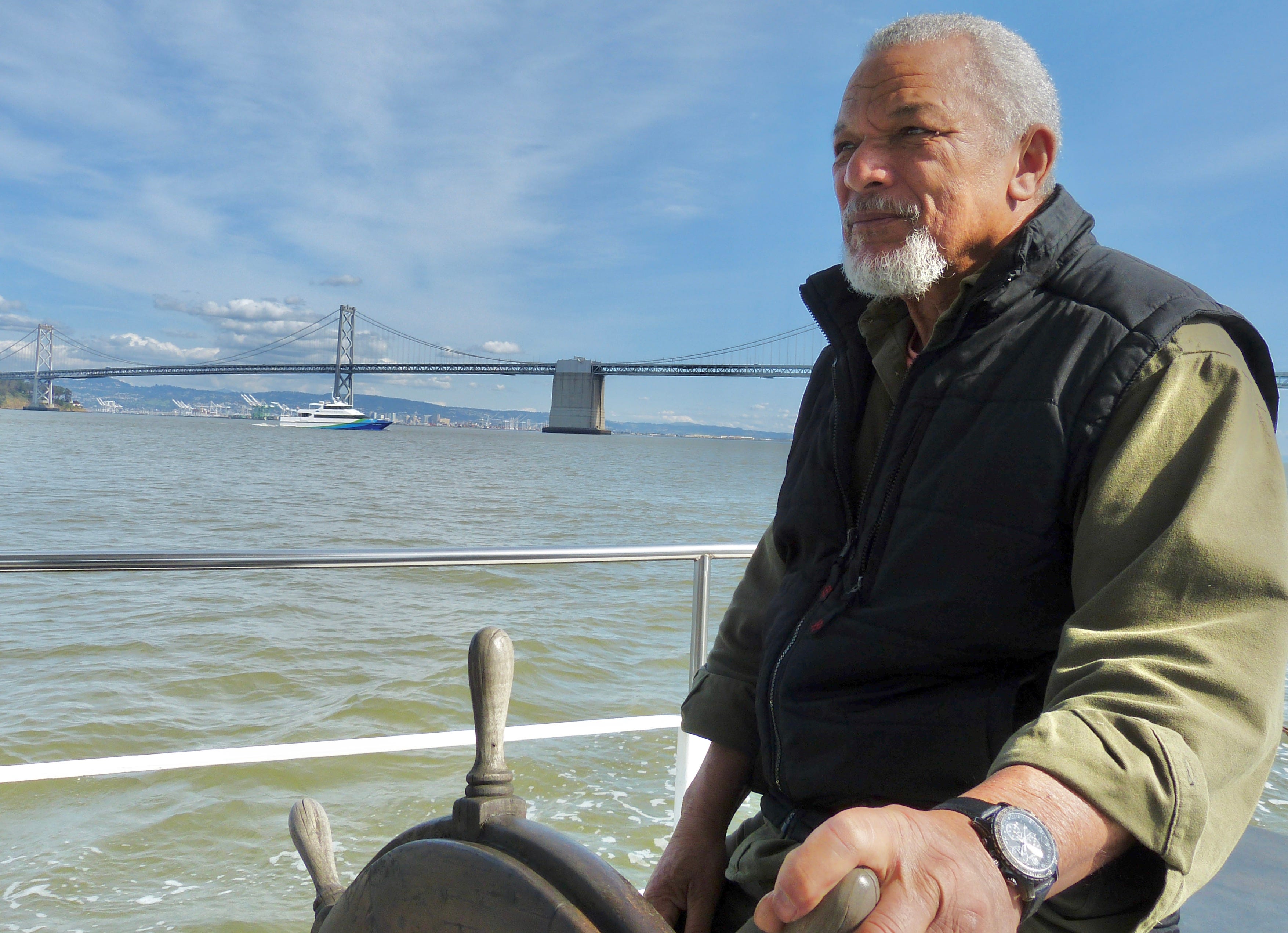
Photo of the H.E. Ross sailing
At what point in this process did you begin writing about your journey? Was it the entire time or gradually?
I started writing in Point Reyes Station. I had a freelance maritime column where I wrote about boats. Now this wasn’t directed toward my African heritage, just the boats themselves, and how they’re constructed and what the people are like around them. I’d been sailing for 12 years or so at this point. A sailor, and into sailing folk, who are a different breed of people. But I still hadn’t related it to us.
I got a temporary janitor job at the San Francisco Maritime Museum, and met the guy who founded it, a man named Karl Kortum, and he used to tell me, “Yeah, yeah, we got records of Black people who were sailing. They came into San Francisco, and set up houses, and would go sailing and fish.” I was saying, really? Because at the time there were 4 or 5 of us on San Francisco Bay out of a population of 600,000 boats. When I began working in the industry, delivering and demonstrating boats, I was the kicker for the guys selling boats, because no one else had a Black man leading demonstrations. Everyone would say, “Oh, if you could sail, I could sail this kind of thing,” and we picked up on that and began to say, “If I could do it as a Black person, you could do it as a white person.” And it worked.
I didn’t mind doing it, and I made money. I would do deliveries no matter the weather. It was a rough time. I didn’t care. I just wanted to be on a boat. The writing about sailing only took place when I started promotion for the Bay Area Institute. I learned a lot from Karl Kortum. He introduced me to a man who owned the oldest boatyard in San Francisco, Peter, and he showed me all these photographs of people who worked at his yard, who were Black and Polynesian and Chinese, non-white people all of them. Thousands of photos he eventually donated to the Maritime Museum.
Those two, and a woman named Mary Crowley, who was the head of an organization for the advancement of sailing, are who introduced me to this history. I tried hitting her up for money for my project, but I couldn’t even spell invisible properly. She corrected me, and we became friends. I then went to the Caribbean. I got a job in a newspaper and magazine as a freelance writer.
How did this evolve into Invisible Sailors, Invisible Ships, once you went to Cayman?
When I left for the Caribbean, I was already focused on my Project ISIS and documenting 14 aspects of Black sailing cultures. That was the point of the project, and I was following the African Osiris-Isis legend to do it.
I started with Cayman, and then stuck with what became a gigantic, almost invisible sailing history. People usually just think about the financial industry when the Cayman Islands is mentioned but they were turtlers for over 300 years. The hunting of turtle was learned by the early inhabitants from the Miskito Indians of Nicaragua and Honduras. So I went to Nicaragua and found Caymanian Catboats still in use as transportation, and to hunt Green Sea Turtle. Turtle could be kept alive for long periods of time and became invaluable to the fleets of all nations during the era of sail and Cayman’s geographical position in front of the Windward Passage back to Europe made turtle capture and selling a very profitable business.
During my time on Cayman we re-started the Cayman Catboat Club and featured cash prize Catboat racing. Twelve Caymanian cat boats were built and restored. The Catboat design came from the imagination of Cayman Bracker, Dan Jervis, in the 1930s specifically for turtle fishing but also general fishing and was used as the pickup truck for Grand Cayman Island. In the early 1960s, Grand Cayman did not have a road all the way around the island through its center. You had to go by boat.
An unfortunate number of ship jumping survivors who landed on the Cayman Islands were trained shipwrights and the tradition and heritage of shipbuilding made Caymanians probably the most respected ship builders and even mariners in the Caribbean Basin.
I went from Cayman to the Turks and Caicos after hearing that they still dove conch under sail. When I arrived I found that I was, like in Cayman, a little bit late and there were only a couple of conch sloops left and they were in bad repair. Years later, I returned to the Turks and Caicos Islands and my partner, Katya and I assisted the creation of a Turks and Caicos Maritime Heritage Federation to preserve traditional sailing skills and as a result fourteen Caicos Conch Sloops were built or restored with the incentive of cash races to support primary school educational programs.
Reconnecting people to their ancestral histories of sailing seems to be a through line in your work. Being one of five Black Sailors in San Francisco, despite this history of Black sailors and dockworkers, and then going to Cayman to build this institute that connects people with their histories. What have you learned about ancestral connection to water?
The N-word…We dealt with the upper level of the elementary, primary schools. Kids in the sixth grade, basically about to go into high school. Those kids were so excited about it and they felt it as a natural connection. To say that to an adult is a different thing, especially on an island that’s dealing with tourism. Islanders know that the tourist has a certain image of them and eventually the image, when the cultural entity is absent, can become you. When the history and heritage is looked upon as an era of poverty in place of a time of innovation and cultural development that tourism image becomes more important to maintain. I arrived coming from a different, almost opposite direction in looking at the value of their heritage under sail and that was not always a welcomed perspective.
“Native boat” is sort of like the N-word to me because that’s the way that some people see it. White and Black tourists on Caribbean islands usually don’t see that black people are sailing. Even if they go to an island and see them on sailing boats, they’ll think, oh, they’re on “native boats,” so, somehow, that native boat doesn’t count as a sailing boat and that Black sailor isn’t really sailing it since it is just a native boat.
I have been told by not just white people that black folk don’t sail, inferring that only white people sail and brings us to the question of why is sailing important? To answer that as a sailor who has many years in his wake I can go toward the meditative reality it puts you in but I will focus on the historical uses.
There is a misconception about a yacht and a boat and through that since sailing is not used much in Western societies for commercial reasons outside of racing, we usually think of yachting as sailing. Where, in the Indian Ocean and parts of the Caribbean Sea sailing is used commercially, pleasure sailing vessels are yachts and vessels moving under sail are boats. And in those areas, yachts are what white folk have and sailing workboats are generally sailed by those of a darker color.
In reality the concept of yachting is new but commercial sailing is ancient, even prehistoric.
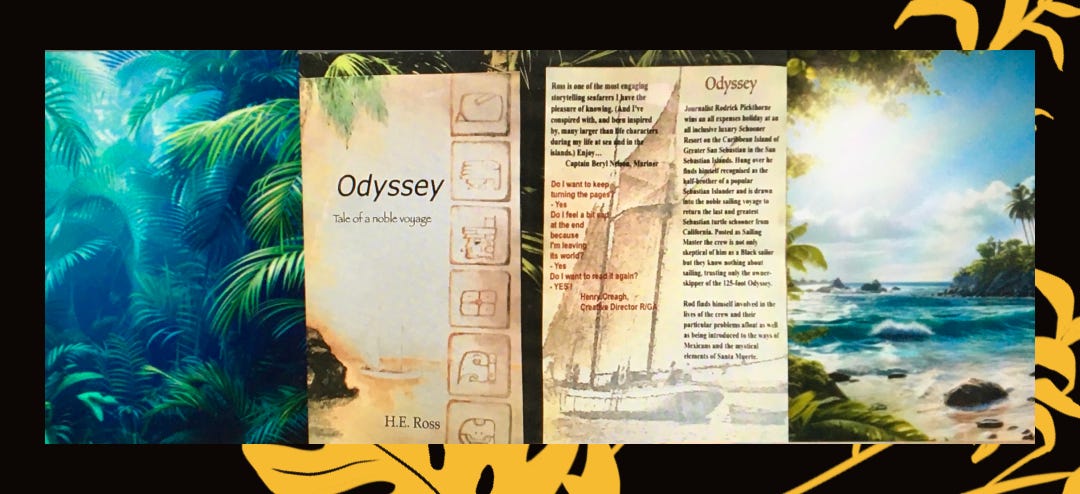
“Odyssey: Tale of a Noble Voyage” by H.E. Ross
Some people say that community organizing is an art practice and that the world is our canvas. Do you think that sailing is a creative practice? Is being at sea, working with the water and boats an expression of your creative energy? How do you bridge your creative energy through writing and sailing?
I am trying to put a creative program in a website form. I start to explain in a simple way a story about how I imagine sailing developed. I also say that we, Africans, created sailing possibly around 70,000 years ago. Since maritime history is written mostly from a focal point in the Mediterranean Sea, including the countries of North Africa that have been turned into non African, it is easy to see why are not included if we are below that geography. Those North African countries are modernised with Mediterranean complexions which seems to make them okay to be included in sailing maritime histories and that history starts only 6,000 years ago in Egypt.
But, what do you know about sailing histories South of Egypt?
In the earliest DNA findings of a human we start in the delta region of middle Eastern Africa, just West of the Horn of Africa. The next DNA finding is about 16 miles to the East of Djibouti in Yemen.
Why would you go 1600 miles (2600 kilometers) North up to Egypt to some place you don’t even know, and try to cross a land bridge over to the Arabian Peninsula and travel the same length down to Yemen? Of course they must have walked over the Red Sea, or the Martians came, picked them up, and put them down over there. I mean, it can’t be that they got in a boat. Right? So, is that bridging my creative energy with writing? I hope so.
Our understanding of prehistoric Africans is fundamentally flawed. Our ancestors did develop creative energies and logic and were able to conceive what was going on around them. They conceived efficiency regarding movement.
Right now, I’m doing more contemporary research on our historic maritime figures, some say celebrities, of the 18th and early 19th centuries whose realities might relate more easily to be entered into our histories.
Speaking of movement, you are a Black American migrant. I read that you've spent the better part of the last 50 years outside of the U.S. How do you feel about being a migrant? Do you identify with that? Is there a disconnect between being a sailor and being a migrant? I'm just curious about how you negotiate that.
Being a sailor automatically makes you a migrant even if it is just sailing across a bay. A boat is its own country even for a few hours. As for cruising, you can go anywhere and generally be accepted by people as though you were part of their neighborhood. You enter a port and put your home into a culture.
I also think that this also goes back to the original migrants out of Africa. They landed in their next port and were at home because their vessel was their home.
One last thing about the way history is written today. You will almost always read that because of the Monsoon Seasons in the Indian Ocean that the Dhow (an African word) was developed to bring trade from the East to the West, and with the turning of the Monsoon to take trade from the West to the East.
But you will never find it starting from the other direction first. Did those ancient mariners first walk to India, then invent the Dhow and start trading with Africa?
But where did the first people come from?
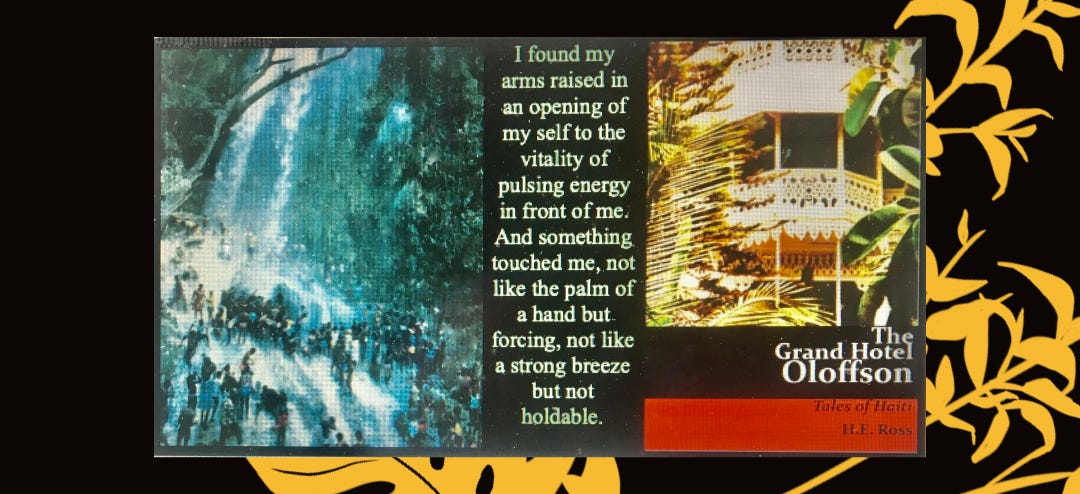
“The Grand Hotel Oloffson: Tales of Haiti” by H.E. Ross
You're based in England right now. In Europe generally, there’s movement of migrants from Africa coming on boats, and these migrants are refugees. I'm curious: what do you think about this new sort of relationship that Black Africans are developing to boats, within this refugee context, as compared to the “native boats” you mentioned in the Caribbean, because I think there is this racialization of certain types of boats that are not yachts, the people who live and work on them, and their relative race and class.
Our trimaran was demolished by two hurricanes in one week and got hit. So we came to England in a state, but my take on those people who are the conservatives, I guess, is what they’re calling themselves. I see them as racists. They’re just going into a history that was told to them about who they are, and they think that this is who they are. A bunch of white people. But they still are never identifying with that. All that starts in one place, and that’s the beginning of any conversation that should be given out. But it isn’t. The conversation has to do with them [refugees] coming here, even though England came to them first.
That part is never talked about too much. The reason that they’re coming here is that they were told it was so wonderful. You know, forget what you’re doing and come and do this. So now they don’t have what they used to be doing, and the only thing that they can do is in England. So why not go to the source of it?
But that conversation isn’t really being had because nobody’s meeting. Everybody that I’ve met around who have been going more in that direction of all “these immigrants coming over” tries to talk to me. I say “I’m an immigrant,” and they say, “Well, no, no, it’s different.” I say, “Yeah, that’s what everybody says.” You know, before you meet somebody, they’re different, but once you see a big group, then they’re strange. They’re alien, and that’s an interesting term from outer space. They’re alien, but my concept is that if there were more conversation, more community activity that deals with conversation and not kind of confrontation, then it would be a little bit different in England.
I mean, what is the Anglo-Saxon? It’s a derivative of the Germanic and the Danish and the French and the and all of that moving into this area. The Celtic and the Norse, that’s coming from the north. Coming from the Nordlands. So they migrated that way. I mean, this is an island itself. Thinking of it as an island is something most English people don’t do, so it’s kind of an interesting little concept to how they’re treating migrants. They have this island sitting here, thinking that it’s the mainland for some reason, but don’t want to be part of the mainland because they don’t do things the “English” way. And you’re going “Well, what is the English way?”
This thing, right now, it’s the only thing politicians have. And it’s what they’re using–I don’t think it’s based on anything. I mean, the people that work at the jobs you don’t want to work at are the people that are coming in to get any job they can get. The hunger is only greed here, whereas the hunger for a migrant is to eat. You know, it’s two different things, and greed has been here. That’s what people are here for: to make money; there’s nothing else there. So I think there’s a way to change that around. It still has to be grassroots and small community things that happen. Like me and these guys saying “You’re different, which in the States is the same thing. It’s exactly the same thing.”
Black people have always been migrants because Black people have always been sailors. In the U.S., because of the transatlantic slave trade, bondage has defined many Black people's relationships to water and to boats in a very particular way. Your work illustrates that black people have always been moving in bodies of water by choice throughout history.
That's it. That's the truth, and it represents freedom. Freedom is something we're always talking about, but when you actually want freedom itself, it isn't getting a job somewhere and working for somebody. You can do that, but you can also have a feeling of freedom. Just by getting on a boat and sailing for an hour and coming back, you can go back to the world knowing you’ve had that breath of fresh freedom. The adventure sitting there. I’ve never liked that term. But if you are adventuring, it means you’re curious. You’re profoundly curious, which is why you migrate. You look out at the same thing that all people looked out on because adventure and the dream are still there. It's the same reason.
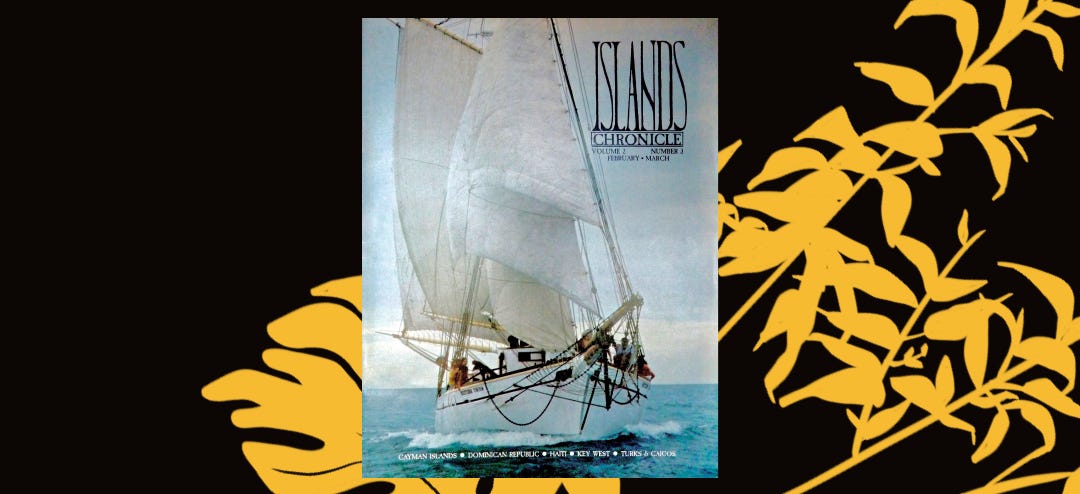
“Islands Chronicle: Vol. 2” by H.E. Ross
Connect with the Authors
Wanaago Geedi
📸 Instagram